
Ready for every flight.
Short, practical lessons for the people who move a flight: gate and check-in agents, ramp and baggage crews, cabin crew, security and station leads. One situation per lesson, the exact words and steps to use, on a phone between flights.
- 100
- lessons
- 20
- tracks
- 10
- areas of airport work
- 5
- minutes each
Most airport training happens at the gate, with a queue waiting, and differently on every shift.
A new hire shadows whoever is rostered, picks up their habits, good and bad, and learns the rest from passengers' reactions. The standard lives in a manual nobody opens on the apron, and the same mistakes come back with every roster change and every disruption.
-
Too long to schedule
A classroom day means pulling people off the operation, so it happens once, at induction, and then the operation changes.
-
Too general to use
A slide about "customer excellence" does not tell anyone what to say to the passenger whose bag did not make the flight.
-
Too rare to stick
Safety and service habits taught once are memories, and faint ones. They need repeating until they become reflexes at the gate and on the ramp.
One situation, five minutes, the words and the steps.
Every lesson takes one real moment at the airport and shows what good looks like, what usually goes wrong and how to recover. A presenter talks it through; the learner reads, listens and answers.
-
One situation per lesson
An angry passenger at the desk, a boarding sequence going wrong, a bag tug near a live engine. The lesson shows the standard, the common mistake and the recovery, with the exact phrases and steps.
-
Plain English, safety first
Written for teams where English is often a second language. Short sentences, no jargon, every aviation term explained in one line, and safety and security before service every time.
-
Checked, not assumed
Each lesson ends with a few questions about what you would actually do, so the habit is tested before the next flight tests it for real.
Built for the whole station, not just the desk.
Tracks are organised by area and by role, so a ramp agent, a flight attendant and a station supervisor each get the lessons that match their day.
-
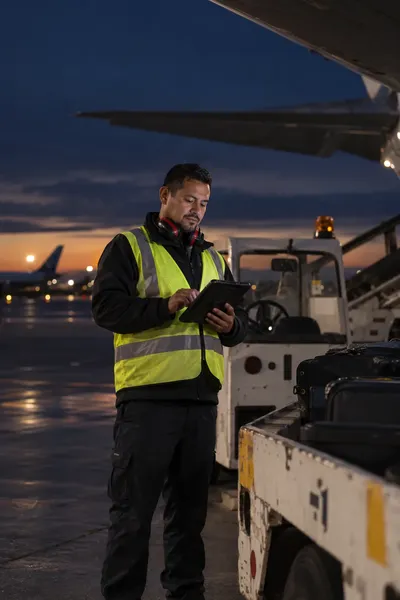
Ramp and baggage
Apron hazards, ground damage, loading, tagging, de-icing and working around live aircraft.
-
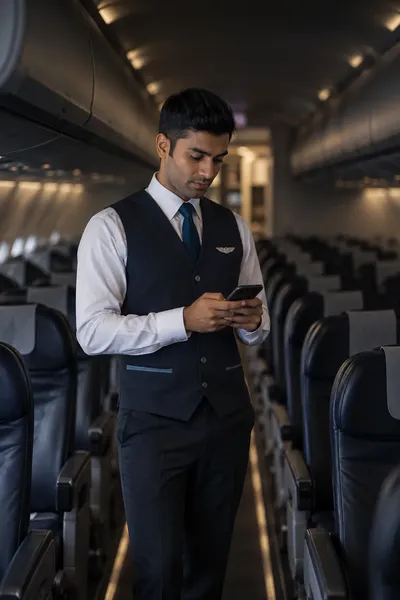
Cabin crew
Pre-flight checks, welcome, meal and beverage service, and passengers who need extra help.
-
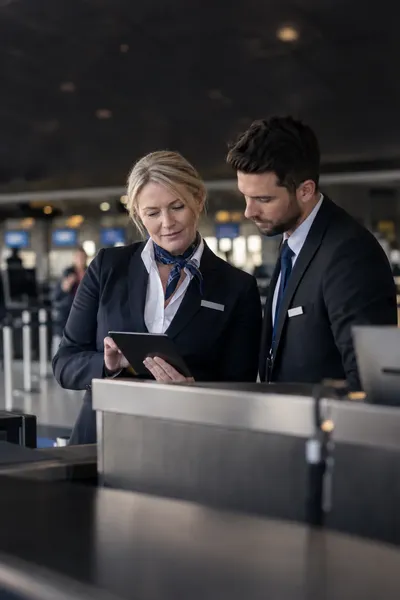
Check-in and gate
First impressions, documents, fees, boarding sequence, announcements and disruption.
-
Station leads and security
Turnaround roles, shift briefings, reporting culture, access control and identification.
Ten areas of airline and airport work, opened track by track.
Every area starts with practical foundations and goes deeper by role. Free tracks let anyone begin; Premium opens the rest for a person or a whole station.
-
Passenger Service and Difficult Situations
3 tracks, 15 lessons- First Impressions at Check-inFree to start
- Clear Communication with Travellers
- Calming an Angry Passenger
-
Boarding and Gate Operations
2 tracks, 10 lessons- Setting Up the Gate Before Passengers Arrive
- Boarding Sequence and Announcements
-
Ramp and Apron Safety
2 tracks, 10 lessons- Apron Hazards and Personal ProtectionFree to start
- Preventing Ground Damage
-
Baggage Handling and Irregular Baggage
2 tracks, 10 lessons- Accepting and Tagging Bags Correctly
- Delayed and Missing Bag Claims
-
Delays and Disruption Communication
2 tracks, 10 lessons- Explaining a Delay HonestlyFree to start
- Rebooking Options and Trade-offs
-
Accessibility and Special Assistance
2 tracks, 10 lessons- Requesting and Delivering Mobility Assistance
- Supporting Passengers with Hidden Disabilities
-
Cabin Service Basics
2 tracks, 10 lessons- Pre-flight Cabin ChecksFree to start
- Meal and Beverage Service Flow
-
Safety and Security Culture
2 tracks, 10 lessons- Why Reporting Makes Everyone Safer
- Access Control and Identification Discipline
-
Weather and Seasonal Operations
1 tracks, 5 lessons- De-icing and Anti-icing Basics for Ground StaffFree to start
-
Teamwork and Station Leadership
2 tracks, 10 lessons- Who Does What in a Turnaround
- Running a Shift Briefing
Lessons describe good practice that applies at any station, never one regulator's rulebook. New tracks are added to the library over time; what you see here is what learners can open in the app today.
Start free. Pay for the rest by the month, the year or the seat.
Free tracks cost nothing. Past them there is one flat price for a person and one price per seat for an airline, a handler or an airport team, in US dollars.
- Free
- Free tracks across several areas: first impressions at check-in, apron hazards, explaining a delay and more.
- $29.99 a year
- Every area and every track, for one person, billed once a year.
- $24.00 per seat, a year
- Per seat for a team or a station, with an invite link, a web dashboard and invoices.
Before you ask
How long does a lesson take?
Is it only for people who speak English well?
Does it replace our regulatory or mandatory training?
Does it work on a phone?
Can we give each team only the lessons that apply to them?
How do we know whether staff actually did the training?
What does it cost?
Tell us about your station.
Say roughly how many staff you have and which areas you want to start with. We answer every message ourselves.
Get in touchStraight to a person, not a sales sequence.